
Walk behind the counter of almost any tour operator, regional airline, ferry line, or destination marketing office and you will find the same scene: a person with nine browser tabs, two green-screen terminals, a channel manager, a spreadsheet, and a phone. The industry has spent two decades layering new software over old systems without ever retiring the old ones. The result is an operational culture where the most valuable skill is knowing which window to click next.
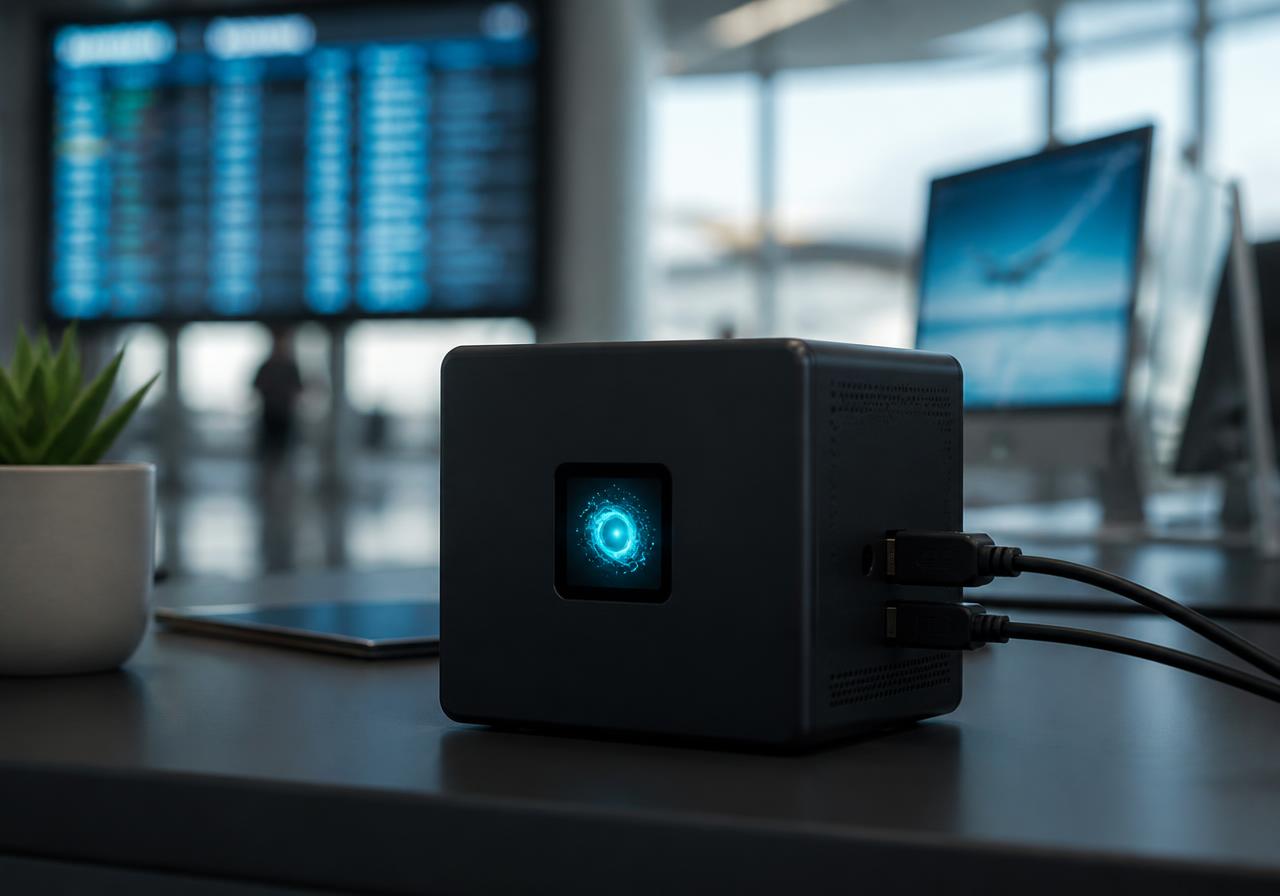
That is the exact seam a new class of hardware is aiming at. Violoop, a compact plug-in AI device currently raising on Kickstarter, does something deceptively simple: it takes your computer's video output over HDMI, reads what is on the screen with an 8-billion-parameter model running locally on a 26-TOPS accelerator, and then acts back on the machine as an ordinary USB keyboard and mouse. No drivers. No API integration. No vendor cooperation. If a human can see it and click it, the box can too.
Travel's software problem was never a lack of AI. It was that the systems holding the data will not talk to anything — including each other.
Why this matters more in travel than almost anywhere else
Most industries that wanted AI automation could buy it through APIs. Travel largely could not. Global distribution systems, airline departure-control platforms, cruise inventory tools, motorcoach dispatch software, and hotel property-management systems are a museum of protocols — some of them older than the people operating them. Integration costs run into six figures and often require the incumbent vendor's permission, which is not always forthcoming when that vendor sells competing automation.
A device that operates the screen instead of the database routes around that entirely. It treats every application as if it had an interface, because visually, every application does. For a regional tour operator running a 1990s reservation system beside a modern channel manager, that is the difference between automation being a capital project and automation being a Tuesday.
The tasks that disappear first
Nothing about this replaces guides, drivers, pilots, or front-desk judgment. What it erodes is the connective drudgery between systems — the work that exists only because two pieces of software refuse to speak.
- Reconciling OTA bookings against the in-house reservation system every morning, line by line.
- Rebooking a disrupted coach or ferry manifest across a dispatch tool, a customer database, and an email client.
- Re-keying group travel rooming lists between a spreadsheet and a property-management system.
- Pulling daily occupancy, load factor, and yield numbers from four dashboards into one report before the 8 a.m. call.
- Checking visa, biometric pre-clearance, and document status for a departing group across three government portals.
- Answering the same twelve pre-trip questions from a knowledge base that lives in a PDF nobody can search.
The privacy argument is the commercial argument
Violoop's pitch leans hard on local-first processing: the raw screen feed never leaves the device, the model runs on-device, and the company claims roughly 2.7 times the local throughput of a Mac mini M4 on the same 8B model. For consumer productivity that reads as a nice-to-have. For travel it is closer to a prerequisite.
Screens in this industry are full of passport numbers, payment instruments, loyalty identifiers, minors' names, accessibility notes, and increasingly biometric match records. Streaming that to a cloud vision model is a GDPR conversation most operators do not want to have, and in several jurisdictions is simply not defensible. Keeping the pixels on the desk turns a legal blocker into a procurement question.
In travel, on-device inference is not a privacy feature. It is the only version of this product that a compliance officer will sign.
What it means for transportation operators
Transportation is where the screen-reading approach gets genuinely interesting, because so much of the sector's critical software is locked, certified, or air-gapped by design. Dispatch consoles, crew-scheduling systems, and maintenance-management platforms are precisely the tools you cannot casually connect to a cloud API. But an operator watching a fleet dashboard for exceptions, cross-referencing them against a driver-hours system, and drafting the reassignment email is doing pattern work that does not require a certification review to assist.
There is a real caveat here. Anything touching safety-of-life systems — air traffic, rail signaling, vessel navigation — will and should stay off-limits to a general-purpose agent. The honest opportunity is in the commercial and administrative layer that surrounds those systems, which is where the labor cost actually sits.
The failure modes nobody is advertising
Screen-driven agents inherit every fragility of the screen. A vendor ships a UI update and the automation silently starts clicking the wrong button. A modal appears at the wrong moment. A model misreads a date field in a European format and books a departure for the fifth of March instead of the third of May. Violoop's answer is a physical confirmation key and an approval step before actions execute, which is the right instinct — but approval fatigue is real, and the whole value proposition erodes the moment someone starts confirming by reflex.
There is also a governance question that travel has not begun to answer. If an agent rebooks a passenger incorrectly, the audit trail needs to show what the model saw, what it proposed, and who approved it. Local processing helps privacy and hurts auditability unless the device logs decisions in a form a regulator can read. Operators should be asking for that log before they ask about the speed benchmarks.
The three-year read
I do not think the specific box matters much. Kickstarter hardware has a mortality rate, and the RK3576-class silicon inside it will be unremarkable within two product cycles. What matters is the category: a cheap, local, vendor-agnostic agent that operates software the way a person does. Once that exists at consumer prices, the moat around legacy travel software stops being the integration barrier and starts being the data itself.
That is the disruption worth watching. For thirty years, the systems that hold travel's inventory have been protected by their own inaccessibility. A device that can read any screen and click any button quietly ends that protection — not by breaking in, but by sitting down at the desk and doing the job the same way the rest of us have been doing it all along.
Source: Violoop.
About Sophia Goehner
Sophia writes about the technology quietly rewiring how we move and where we go. Based in Ithaca, New York.