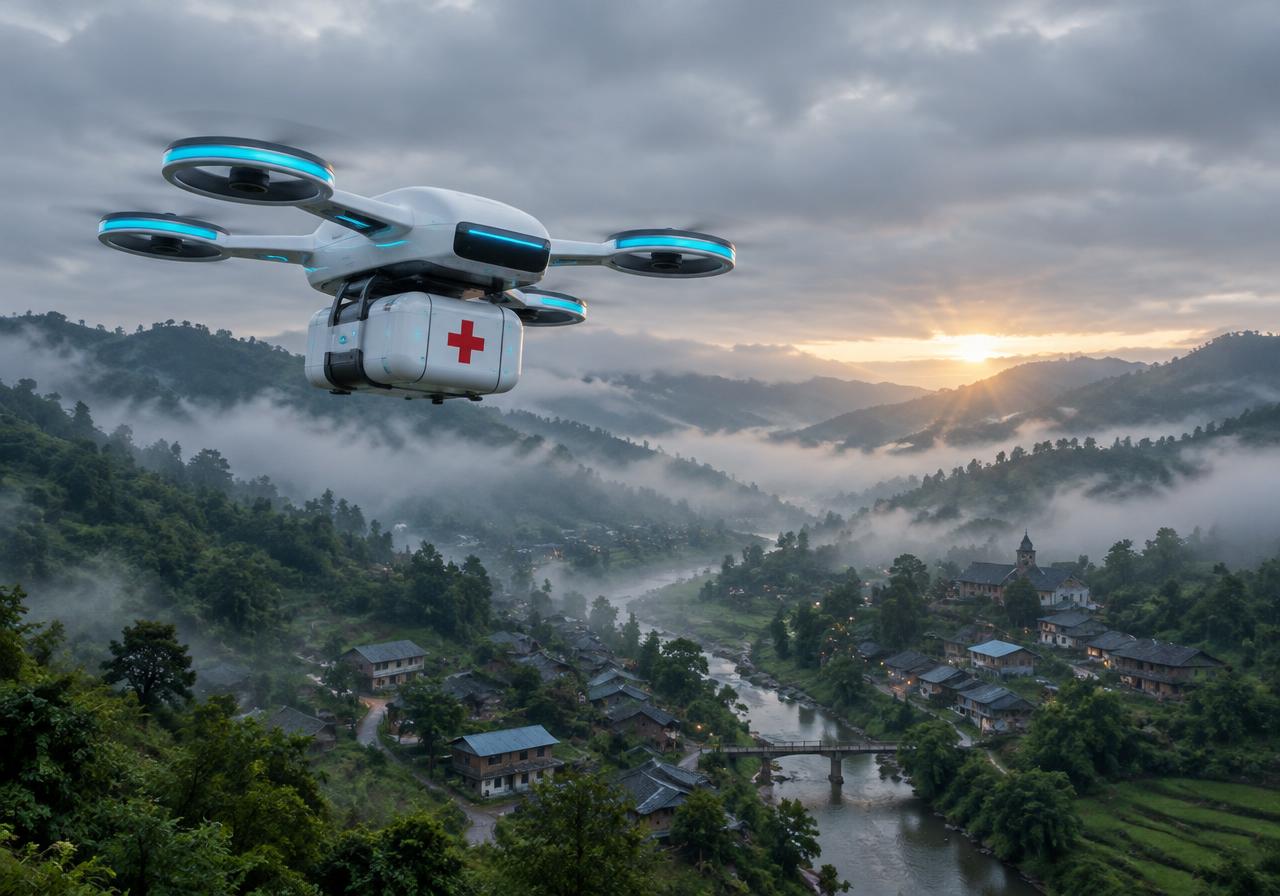
In the hills of Rwanda, a clinic that once waited hours for blood by motorbike now watches a small fixed-wing drone drop a parachute package into a marked zone behind the building, twenty minutes after the request went in. In Ghana, vaccines cross rivers that have no bridges. In Japan's mountain villages, medicine arrives at doorsteps the postman retired from years ago. None of this is a pilot program anymore. It is a Tuesday.
This is the story the technology industry rarely leads with, because it is not glamorous. There is no billionaire, no launch livestream, no waiting list of influencers. There is a nurse, a cold chain, and an aircraft the size of a coffee table that does not care whether the road washed out in the rainy season. And yet humanitarian drone logistics may be the most consequential transportation story of the decade — because it is where the future of all autonomous flight is actually being proven.
The road to the future of travel does not start in a city. It starts where there is no road at all.
Why aid, not e-commerce, got there first
For years the drone-delivery conversation was dominated by the promise of burritos and phone chargers landing on suburban lawns. That version keeps stalling on noise complaints, dense airspace, and the simple economics of replacing a delivery van that already works. Humanitarian delivery sidestepped every one of those problems. A unit of blood is light, urgent, and worth far more than the cost of the flight. The destinations are rural clinics, not apartment blocks. The communities asking for the service are the ones who benefit from it directly — which changes the politics of the sky entirely.
The result is that the world's most mature autonomous aviation networks were built not for convenience but for survival. Operators have logged millions of commercial kilometers, refined their aircraft through dozens of generations, and earned regulator trust flight by flight — in places where a failure is measured in lives, not late packages.
What this means for travel and tourism
Here is the part our industry should be watching closely. Every kilometer flown for a clinic is a kilometer of certified autonomous operations, weather data, maintenance practice, and public acceptance. The corridors being opened over Rwanda, Ghana, and rural Japan are the same regulatory and technical corridors that will one day carry larger payloads — spare parts for a stranded tour bus, medical evacuation for a remote lodge, fresh supplies for an island resort that currently depends on a weekly ferry.
- Remote destinations become safer: a clinic reachable by drone in minutes changes the risk math for adventure and eco-tourism operators.
- Island and mountain economies gain logistics that don't depend on a single road, ferry, or airstrip.
- Emergency response for travelers — a lost hiker, a cardiac event on a trekking route — moves from hours to minutes.
- The certification pathways being written now for cargo drones are the template passenger eVTOL will follow.
There is a quieter effect, too. Communities that experience aviation as something that brings medicine — rather than noise, emissions, or tourists who never leave the resort — tend to welcome the next generation of aircraft. Social license, the thing every urban air mobility startup is desperate for, is being earned right now by drones carrying blood bags.
The technology underneath
The current generation of humanitarian drones is unglamorous and brilliant: electric, autonomous from launch to release, navigable by GPS with onboard contingency logic, and cheap enough that a regional health system can operate a fleet for the cost of a single ambulance. Deliveries are requested by text message. The aircraft does not land — it drops a padded package on a paper parachute and turns for home, which means a single distribution hub can serve dozens of clinics without any infrastructure at the far end.
The next generation is already visible: heavier-lift aircraft for vaccine cold boxes, beyond-visual-line-of-sight corridors approved as routine rather than exception, and integration with the same satellite connectivity that is erasing the travel dead zone. Each layer of that stack — autonomy, airspace management, connectivity — is a layer the passenger transportation industry will inherit.
The humanitarian dividend
It is tempting to treat aid drones as a feel-good sidebar to the real business of moving people and goods. That gets the causality backwards. The humanitarian networks came first because the need was undeniable and the alternatives were worse. What they are building — trust, regulation, reliability data, and public affection for autonomous flight — is the foundation everything else will stand on. When your airport transfer eventually arrives without a driver, or an eVTOL crosses a bay that used to take a two-hour drive, some part of that flight will trace back to a blood drop over a valley with no road.
The future of travel is not being invented in a boardroom. It is being flown, one quiet, life-saving delivery at a time, over the places maps used to give up on.
About Sophia Goehner
Sophia writes about the technology quietly rewiring how we move and where we go. Based in Ithaca, New York.